Home / Platform / GRC Core
GRC Core

The Enterprise
Risk Backbone.

Six deeply integrated modules covering every dimension of enterprise risk - from ERM and TPRM to Audit Management, InfoSec, BCP/DR, and AI Governance. Connected by a shared data model and 40+ AI agents.

6
Core Modules
40+
AI Agents
50+
Compliance Frameworks
SHA-256
Evidence Integrity
Six Modules

Every GRC discipline.
Unified in one platform.

Each module shares a common risk taxonomy, unified issues register, and control library - so a risk in ERM automatically surfaces to Audit, a vendor score drop triggers Compliance, and a BCP event activates InfoSec workflows.

Enterprise Risk Management

ERM  ·  4-Factor Scoring · KRI Monitoring · Basel III

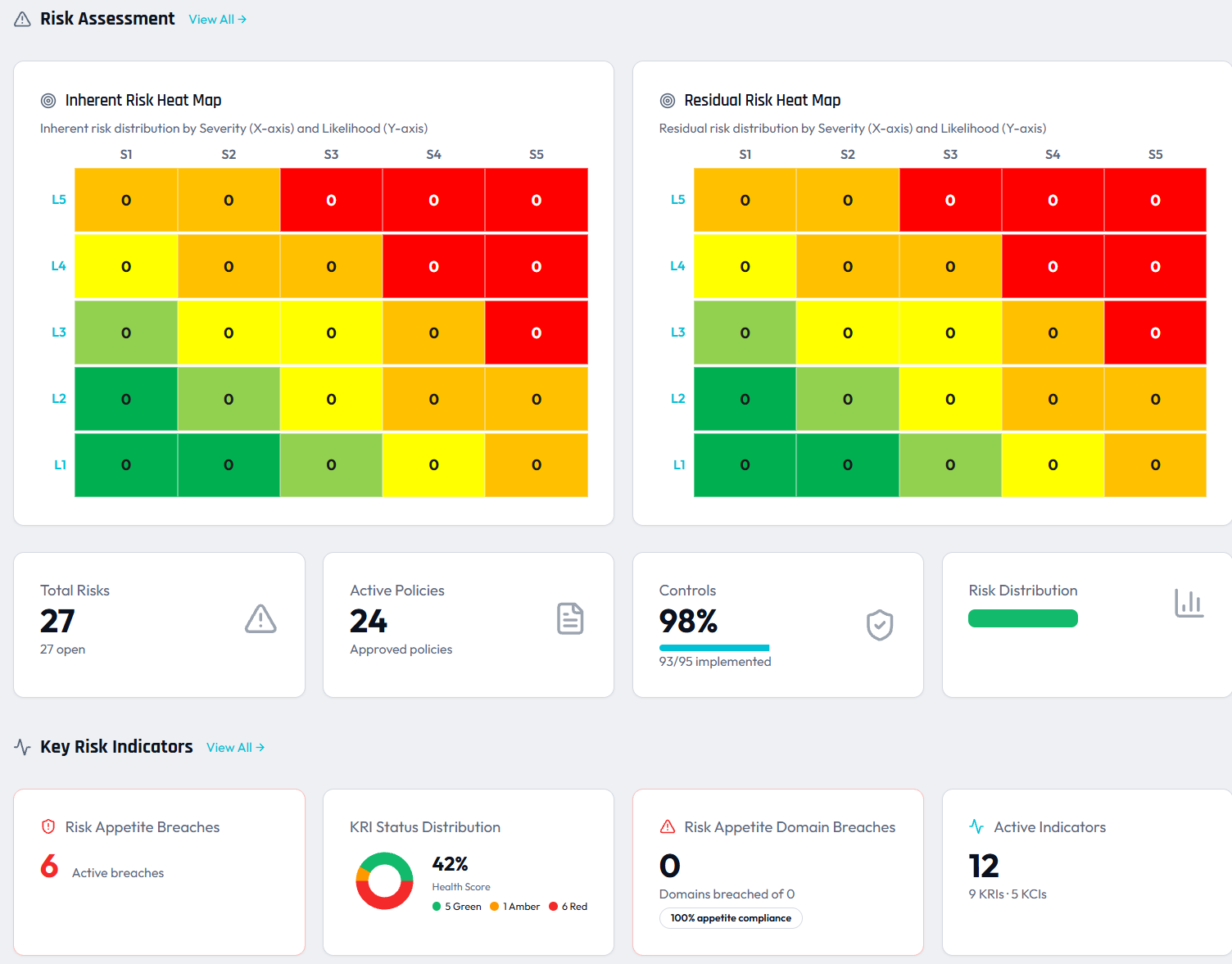
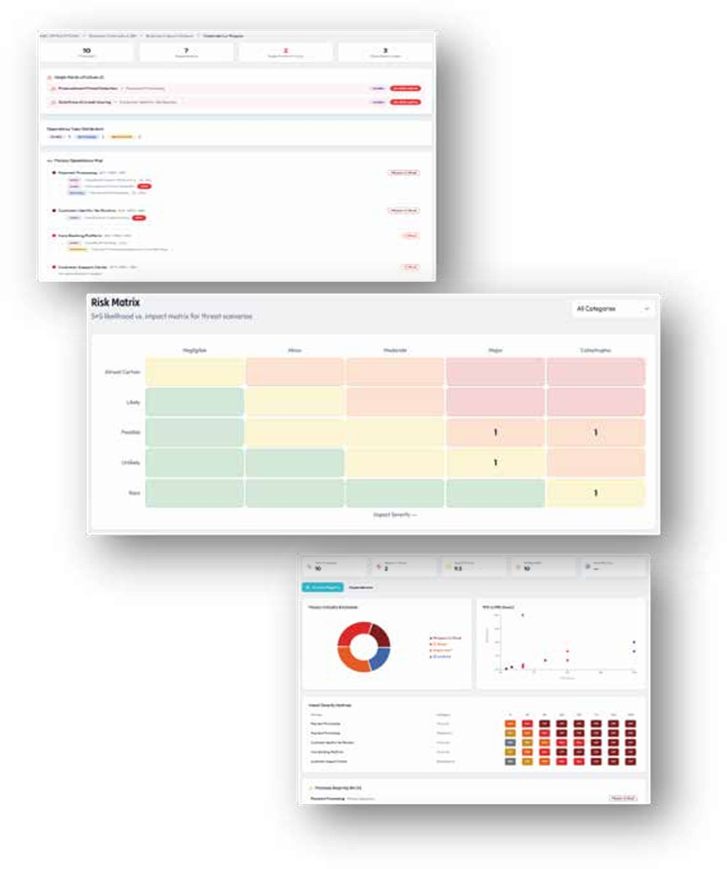
Unified risk registry with 4-factor scoring across Severity, Likelihood, Vulnerability, and Speed of Impact. Inherent/residual heat maps, KRI dashboards with appetite thresholds, Monte Carlo economic capital modeling, and automated escalations when limits are breached.

Risk register with taxonomy management
4-factor inherent/residual scoring
KRI monitoring with appetite thresholds
Heat maps and portfolio risk views
Treatment plan workflow (6-step)
Monte Carlo economic capital modeling
RCSA campaign management
Risk appetite statement and breach alerts
Risk Scoring AgentKRI Monitor AgentCorrelation AgentRisk Appetite Breach Orchestrator

Third-Party Risk Management

TPRM  ·  Vendor Lifecycle · Weighted Scoring · Continuous Monitoring

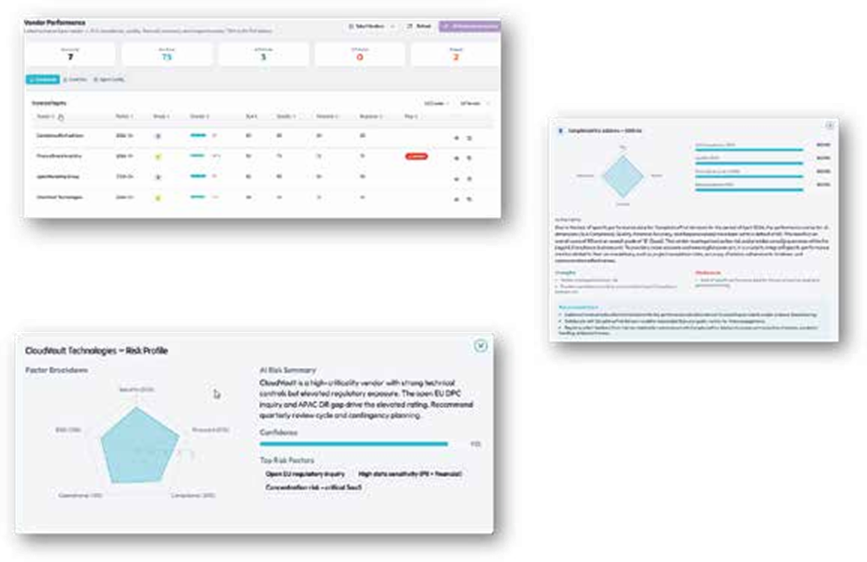
End-to-end vendor risk governance - from initial due diligence through ongoing monitoring and contract expiry. Weighted scoring across Security (30%), Financial (25%), Compliance (20%), Operational (15%), and ESG (10%) dimensions, with AI-driven performance monitoring.

Vendor registry with tiered risk classification
Multi-dimensional weighted risk scoring
DDQ automation (35Q and 80Q versions)
Contract and SLA tracking
Continuous performance monitoring
Vendor incident response workflows
Regulatory impact analysis on vendor changes
Vendor dependency mapping to BCP plans
Vendor Risk Scoring AgentThird-Party Monitor AgentVendor-to-Compliance AgentBCP-to-Vendor Dependency Agent

Audit Management

AUD  ·  SOX · ISO · NIST · Risk-Based Planning

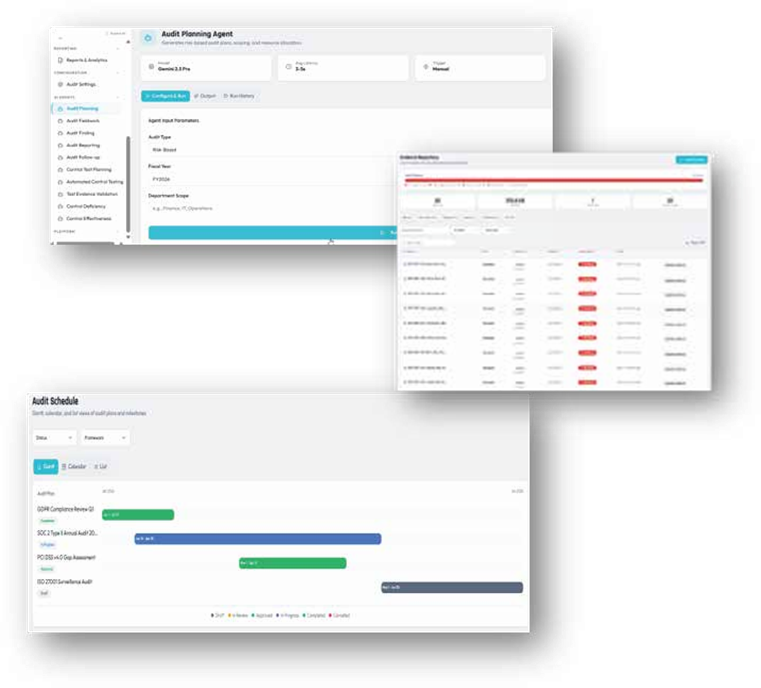
Full audit lifecycle from risk-based planning through fieldwork, reporting, and remediation follow-up. SHA-256 evidence hashing ensures tamper-proof audit trails. Framework-aligned plans for SOX 404, ISO 27001, NIST CSF, and custom frameworks.

Audit universe and risk-based planning
Workpaper generation with SHA-256 evidence hashing
Control testing with automated evidence collection
Finding management and owner assignment
Remediation workflow with deadline tracking
Audit Committee reporting packages
Follow-up testing scheduling
Finding-to-issue automatic linkage
Audit Planning AgentEvidence Auto-Collection AgentFinding-to-Remediation AgentAudit Committee Package Agent

Information Security

InfoSec  ·  NIST CSF 2.0 · ISO 27001 · CIS Controls v8

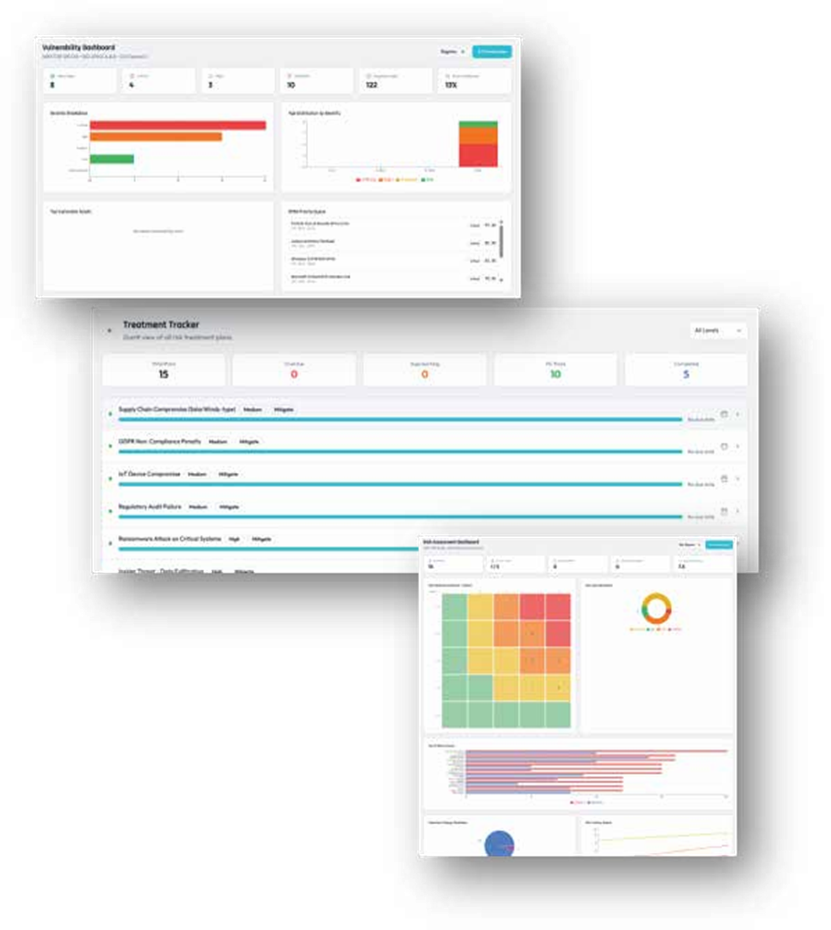
Comprehensive cybersecurity risk and compliance management. CVSS/EPSS/Asset Criticality weighted vulnerability prioritization, SOD and dormant account detection, 5-dimension security posture scoring, and 15-minute CVE/IOC threat detection with automated incident response orchestration.

Vulnerability management with CVSS/EPSS scoring
NIST CSF 2.0 and ISO 27001 framework alignment
Access reviews with SOD conflict detection
5-dimension security posture scoring
Threat detection and CVE/IOC alerting
Security incident response workflows
Configuration compliance monitoring
Automated pen test finding tracking
Incident Response OrchestratorThreat Detection AgentCompliance ScannerSOD Conflict Monitor Agent

Business Continuity / Disaster Recovery

BCP/DR  ·  RTO/RPO · Tabletop Exercises · Recovery Orchestration

End-to-end business continuity and disaster recovery management. Business Impact Analysis automation, dependency mapping from processes to systems to vendors, tabletop exercise management for Cyber, Natural Disaster, Pandemic, and Vendor Failure scenarios, with automated recovery orchestration.

Business Impact Analysis (BIA) automation
Dependency mapping: processes to systems to vendors
Tabletop exercise agent for 4 scenario types
RTO/RPO validation and gap analysis
Recovery strategy documentation
Communication cascade orchestration
Crisis event declaration and escalation
Regulatory reporting on continuity events
Tabletop Exercise AgentRecovery Orchestration AgentBCP-to-Vendor Dependency AgentBCP Activation Agent

AI Governance

AI Gov  ·  EU AI Act · NIST AI RMF · Model Risk SR 11-7

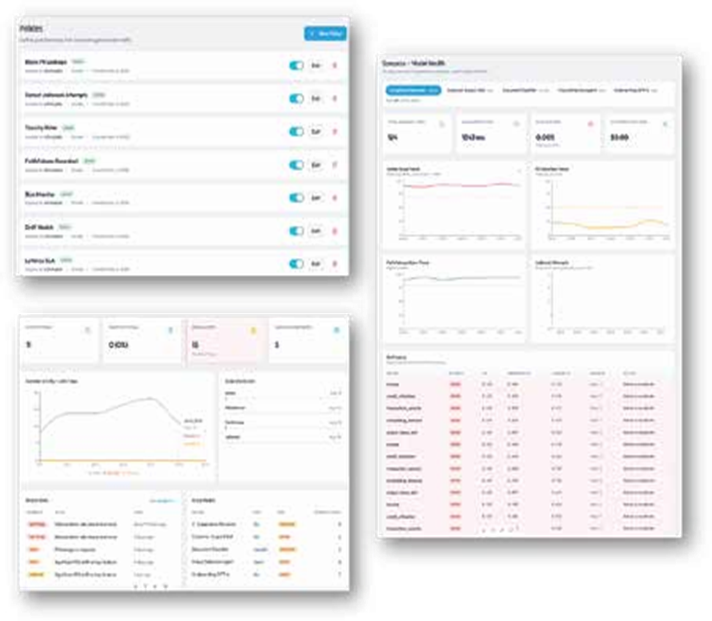
Governance, risk, and compliance for artificial intelligence systems. Maintains a complete AI system inventory, classifies systems by risk level per the EU AI Act framework, monitors model performance and bias, manages model risk per SR 11-7/OCC 2011-12, and ensures explainability for adverse action notices.

AI system inventory and risk classification
EU AI Act conformity assessment support
Model bias detection across protected attributes
Explainability reports for adverse action notices
Model performance drift detection (PSI, KS)
NIST AI RMF alignment and gap assessment
AI incident detection and response
AI ethics review workflow
AI Model Bias Detection AgentEU AI Act Compliance AgentModel Performance Monitor AgentAI Incident Response Agent
Cross-Module Intelligence

One event. Automatic cascade.

Remedy unified data lake enables real cross-module triggers - the kind of intelligence impossible with siloed point solutions.

Risk → Audit Pipeline

When a risk is rated Critical or High, Remedy automatically creates an audit plan entry, assigns auditors by skill, generates the audit scope, and schedules the engagement - zero manual intervention.

Vendor Risk → Compliance

When vendor risk deteriorates below threshold, Remedy triggers a compliance gap assessment, updates control effectiveness ratings, and generates regulatory impact analysis across all affected frameworks.

InfoSec → TPRM Reassessment

An InfoSec vulnerability automatically triggers a TPRM vendor risk reassessment and updates Model Risk records - connecting a technical finding to its third-party and model risk implications in real time.

BCP Crisis → Response Chain

A declared crisis event automatically creates InfoSec remediation tasks, activates the Recovery Orchestration Agent, notifies business owners, and initiates the vendor contingency workflow.

Frameworks Covered

50+ frameworks. Pre-mapped on day one.

COSO ERM
ISO 31000
Basel III Operational Risk
NIST CSF 2.0
ISO 27001:2022
CIS Controls v8
SOX 404
PCAOB AS 2201
SR 11-7
OCC 2011-12
FFIEC IT
OCC Heightened Standards
NIST 800-53
FedRAMP
CMMC 2.0
BCI Good Practice Guidelines
ISO 22301
DORA ICT Risk
EU AI Act
NIST AI RMF 1.0
ISO/IEC 42001

See GRC Core in action

Book a personalized demo and see how Remedy six GRC modules work together to deliver always-on risk intelligence.

Book a Demo Platform Overview